Travel Report: Morocco—From Marrakesh to Agadir via Ouzoud, Ouarzazate, and Merzouga
Discover the highlights of our road trip from Marrakech to Agadir, via Ouzoud, Ouarzazate, and Merzouga in the Sahara
Our Morocco travelogue summarizes the best highlights and “must-sees” for you, so you, too, can have an unforgettable trip. We were there in March, when temperatures are pleasant (around 20 degrees during the day, around 5–10 at night) and there are slightly fewer tourists than during peak season. Our Morocco travelogue takes you through bustling Marrakesh (though there’s also a detailed travelogue about this city on our site), then on to Ouzoud, to the waterfalls and the last remaining Barbary macaques, and from there via Ouarzazate—home to the world-famous Aït Ben Haddou—on through the Dades Valley into the Sahara to Merzouga, where we filmed the fennec fox. The tour concludes in Agadir, where you can relax and unwind.
Where is Morocco located?
Things You Should Definitely Keep in Mind When Traveling to Morocco
Local currency: Moroccan dirham (MDH). You can use your credit card almost anywhere for payments or cash withdrawals. However, you’ll need cash for taxis, small purchases, and especially for tips, which are expected everywhere.
Vaccinations: No vaccinations are required for travelers coming from Germany. However, it is recommended that you consult a doctor before your trip to have your vaccinations checked. Any doctor can provide more detailed information, or you can contact the Tropical Medicine Institute if necessary.
Visas: German citizens do not need a visa for Morocco if their stay does not exceed 90 days.
Can I bring a drone to Morocco?
The short answer is NO. Morocco currently still has very strict drone laws, and the least that can happen to you is that you’ll have to hand over your drone at the airport and can pick it up again when you leave the country. Some websites now also report that you can apply for permission to fly drones in Morocco. At the time of this report, we were unable to find any option that would have worked for private use.
Detailed Travelogue: Morocco—Important Questions:
Is Morocco inexpensive?
In general, the cost of living and hotel rates are significantly lower than in Germany. However, it depends a lot on the time of year. During peak seasons, such as around Christmas and New Year’s Eve, hotel rates can quickly rise to two or three times the normal price, and then it does get expensive—though still not at the level of Dubai, for example. Restaurants—especially authentic Moroccan ones—are really inexpensive. However, there are now also many up-and-coming hotels and restaurants that are definitely aligning their prices with European standards.
Is Morocco safe?
We never felt unsafe at any time of day or night. There’s a strong police presence, and there are also a lot of undercover officers who aren’t immediately recognizable. That always makes you feel safe. Moroccans are also an extremely friendly people, and even at the markets, a simple “No, thank you” was enough to be left alone. We’ve had different experiences in countries like Turkey.
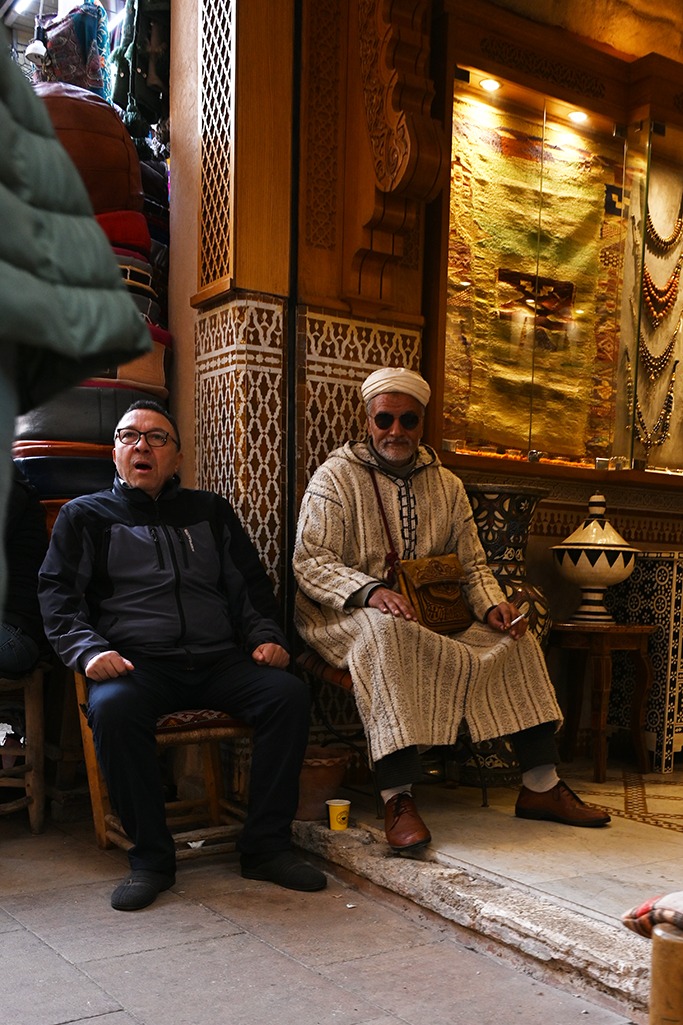
Car Rentals in Morocco
A road trip in a rental car in Morocco is completely hassle-free. When booking, be sure to note the pickup time, as it’s strictly enforced. If you arrive too early, the rental car may not be available yet. We always book the all-inclusive package through Check24, which provides full coverage—something we recommend to everyone. When picking up the car, however, be sure to check everything and have any damage documented. The vehicles from the major rental companies are generally in good condition, but significantly older than those in Europe. One-way rentals are also available, but they cost extra.
Fueling up is hassle-free. You simply pull up to the gas station, and an attendant will come right over to help you fill up. If you’d like, you can also have the car washed completely for a few euros. It’s usually a hand wash and works great.
When using Google Maps, keep in mind that the estimated travel times are generally at least 50% too short—for example, a two-and-a-half-hour estimate on Google is more like a four-hour drive. However, you can always rely on Google’s route guidance; it works excellently.
Speed limits and how they’re displayed in Morocco are a bit of a gamble. As a rough guide, the limit is 60 km/h in built-up areas and 80 km/h outside of them. Especially near construction zones, though, you’ll quickly find yourself slowing down to 40 or 20 km/h—though nobody really sticks to 20 km/h.
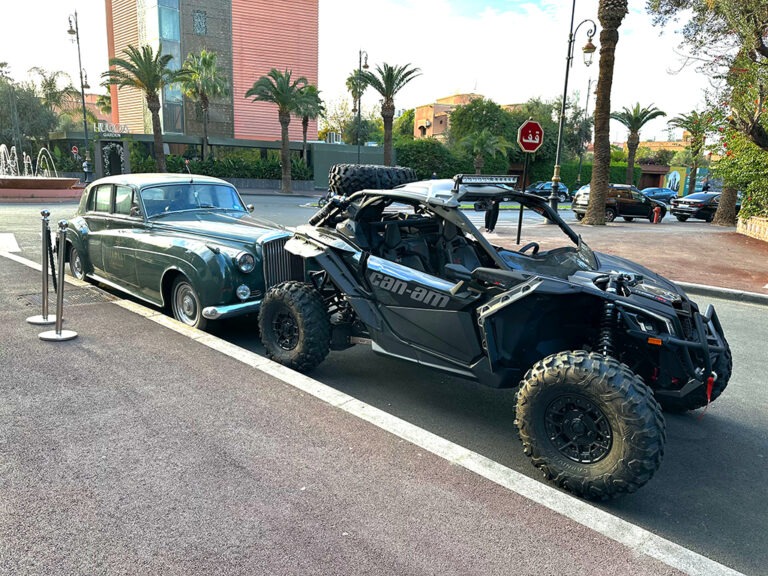
Police checkpoints
If you’re traveling in a rental car, you’ll have to get used to frequent police checks.
The police conduct checks at regular intervals, though it’s unclear what criteria they use to pull cars over. Typically, these checks involve verifying your documents and, if applicable, checking for speeding violations—which you should avoid at all costs in Morocco.
During police checks, they’ll ask to see your driver’s license, passport, and vehicle registration. You should always have these on hand.
Of course, we got pulled over on the road as well. For going 7 km/h over the speed limit, you’ll pay the equivalent of 15 euros or 150 dirhams. You’ll receive a receipt. Generally speaking, the police are very friendly. For example, they’ll read the violation to you using a translation app on your smartphone in English or another language of your choice. This ensures there are no misunderstandings. You have to sign the receipt you receive, and then the matter is essentially settled.
Is English enough for Morocco?
In addition to Arabic, the second language in Morocco is French, and older people in particular understand very little English. Among young people, however, it’s a completely different story. They generally speak English fluently. You should have at least a basic knowledge of French, if only for negotiating with taxi drivers; otherwise, the calculator on your cell phone will do the trick. Everyone appreciates a “Hello” or “Goodbye” in French, though.
Experience the Highlights of Morocco
Travel and Entry
We flew directly from Munich to Marrakech. Because of Ramadan, Morocco had decided to set the clocks back by one hour. Just like last time, we’d expected long lines at immigration, but this time we were able to clear customs very quickly again using the fast track for business-class travelers and, factoring in the time difference, arrived at our Budget rental car counter two and a half hours ahead of schedule. Here we encountered something new. The employee wouldn’t let us pick up the car early—we’d never experienced that before, no matter where in the world we’d rented a car. But he said the car wasn’t there.
Rather than wait 2.5 hours at the airport, we decided to take an Uber (yes, Uber is available in Morocco) directly to the hotel and check in first, instead of just sitting around waiting at the airport.
When we arrived at the hotel, unfortunately our room wasn’t ready yet either, so we had to wait 30 minutes for it. However, the staff member gave us a nice suite and also invited us for tea to help pass the time.
Half an hour before the scheduled pickup time for the rental car, we headed back to the airport to pick it up.
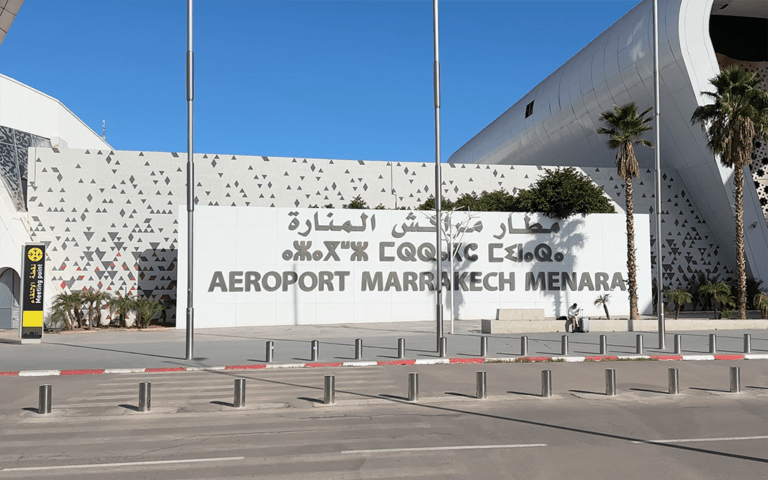
Marrakech
Le Méridien Nfis - A Classic Marriott Hotel
Once again, we chose Le Méridien N’Fis, a hotel in Marrakesh that we consider unbeatable in terms of value for money and which is also conveniently located—provided you don’t mind walking 20 minutes into the city or taking a taxi for 4 euros. You can find a detailed travelogue about Marrakech itself on our website, so we won’t go into further detail about the highlights here.
Onward journey to Ouzoud, to see the Barbary macaques and the waterfalls
Today we’re heading to Ouzoud. It’s early March, and contrary to expectations, it’s much colder than we thought, so on the drive to Ouzoud we even pass through snow-capped mountains. According to Google, the drive takes 2.5 hours, but in reality, it takes closer to 4–4.5 hours. This is mainly because the speed limit is usually only 60 or 80, and you have to drive much slower on many mountain passes. Of course, we also had to deal with the snowfall.
We decide on the Hotel Borj des Cascades in Ouzoud because of its fantastic location. The Hotel Borj des Cascades doesn’t have a parking lot, but you can park right on the street in front of it, which is a bit unusual. When we arrive, we’re not sure if the hotel is even open, since all the lights are off and the lobby is very dark, but a friendly gentleman lets us into the reception area. The hotel is the best one in town and has about 200 rooms. We realize that we’re the only guests. It reminds us a little of the movie *The Shining*. It’s a somewhat strange atmosphere, but the room itself and the view of the waterfalls from the room are truly beautiful.
Breakfast at the hotel is unique because we’re the only guests. At first, we’re a little unsure whether there will even be breakfast, and suddenly a lavish breakfast spread is brought in on a serving cart.
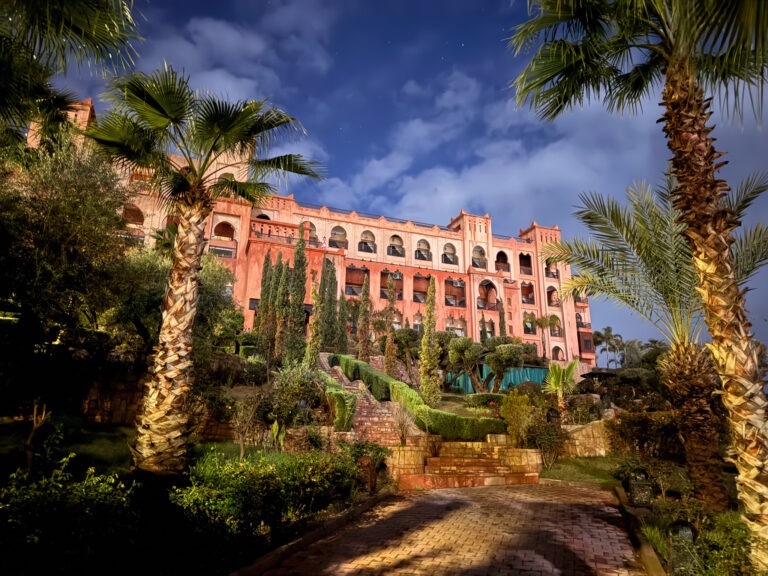
The Ouzoud Waterfalls
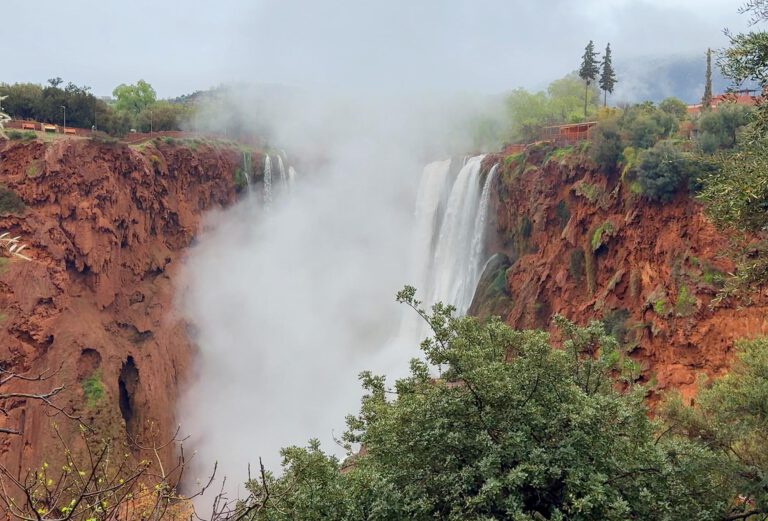
Since it’s now early afternoon, we head down to the waterfalls first and plan to grab a bite to eat at one of the restaurants there. Here, too, almost all the shops are closed due to Ramadan, and there are hardly any visitors, except for a few tour groups.
We talk to some locals, who explain that there hasn’t been as much rain and snow in recent years as there has been this year. As a result, the waterfalls are flowing full and are therefore very impressive.
The Barbary Macaques of Ouzoud
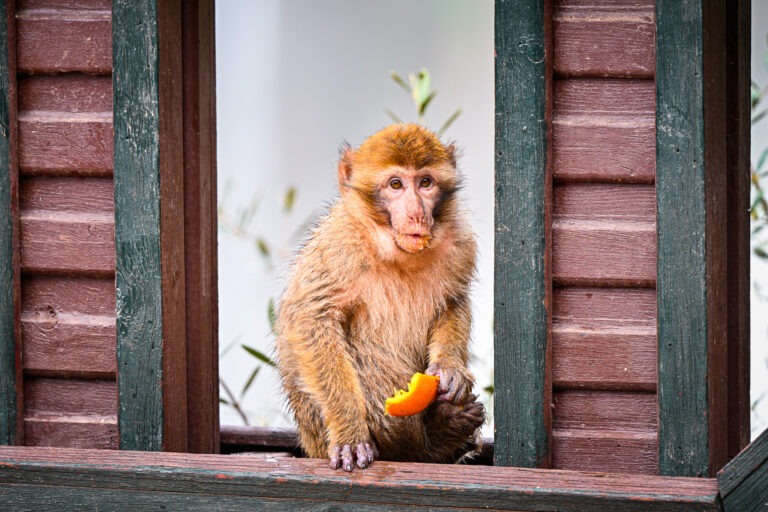
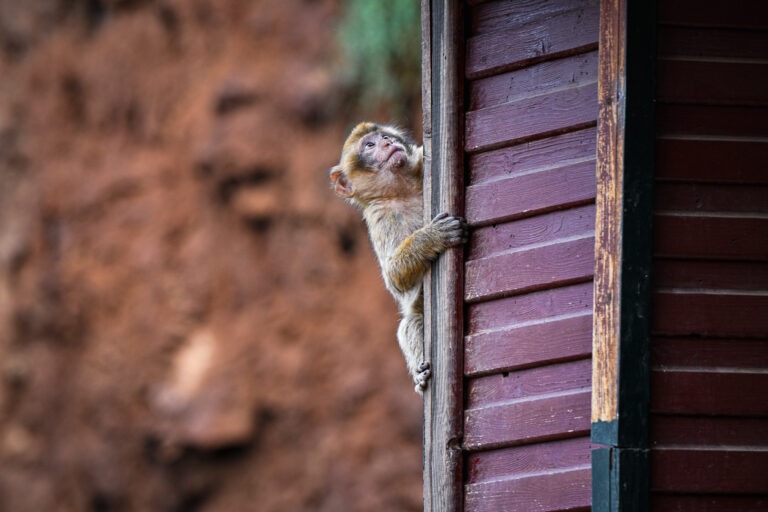
Besides the waterfalls, the Barbary macaques were our real goal, and it doesn’t take long before the first ones make an appearance. As is the case everywhere, they’re mainly out looking for food and expect a little treat from the tourists. We’re not big fans of that and don’t want to feed the monkeys.
Restaurants in Ouzoud
The restaurants are completely empty, but a few are open. We decide on the restaurant Des Amis, which has a great view right of the waterfalls, and the lunch is truly hearty and delicious. Definitely worth recommending for the friendliness, service, and food.
It doesn’t take long before the first Barbary macaques spot our food and make their way toward our table. It’s a bit of a challenge to keep them away from the food. In the end, we’re happy to leave them the dessert—raisins and oranges—(though not entirely willingly), and we replace the broken bowl for the restaurant.
We spend the rest of the afternoon at the hotel. On the way back, we stop by Chez Mounir and reserve a table for the evening.
When we get back around 8:00 p.m., we realize that we’re practically the only guests and that, contrary to what we thought, the restaurant isn’t closed but is keeping the doors open—which is a bit of a challenge given the temperatures. The food, however, is delicious—Mom is the one cooking—and the small open fireplace provides some warmth, though it leaves our clothes smelling of smoke afterward.
We’re served more than we can eat, but Mounir tells us that he has 11 dogs who’ll be very happy with whatever we leave behind.
Continuing on to Ouarzazate
We have 211 km ahead of us, and the driving time is listed as 4.5 hours—which, once again, is far too short.
The highest point on the route between Ouzoud and Ouarzazate is on the road through the High Atlas, specifically at the Tizi-n-Outfi Pass, which sits at an elevation of about 2,150–2,200 m and is quite a challenge, as we’ll soon discover.
At first, the route is still easy going, but we soon realize that it will take us right across the Atlas Mountains, over some very challenging mountain passes. After just a short while, we reach the first snowfields, and the mountains and washouts have plenty of mud and debris in store for us.
We drive higher and higher into the mountains, and after about an hour we have to stop for the first time. There’s a traffic jam because a truck has tipped over on the muddy roads in a hairpin curve, and we’re hoping this blockage can be cleared quickly, since we really don’t feel like spending the day in the Atlas Mountains.
After about 30 minutes, we’re on our way again, and we thought we’d already made it through the worst part, but things turned out differently. We’re glad to have a 4×4, because the tires aren’t the best, and we’re now driving over ice and scree fields like we’ve never experienced on any of our other trips. We even have to cross a river at the end, driving through water about 50 cm deep.
Every time we think we’ve made it through a mountain range, an even higher one appears. After a good 5 hours, we finally leave the Atlas Mountains behind and drive down to Ouarzazate.
When we arrive at the hotel, we realize that the trip has taken its toll. A piece of the plastic underbody guard on the engine has broken off and is hanging down. However, the hotel staff quickly arrives with tools, and the broken piece is simply cut off and thrown away. We’d rather not speculate on whether the car would pass the TÜV inspection in Germany in this condition.
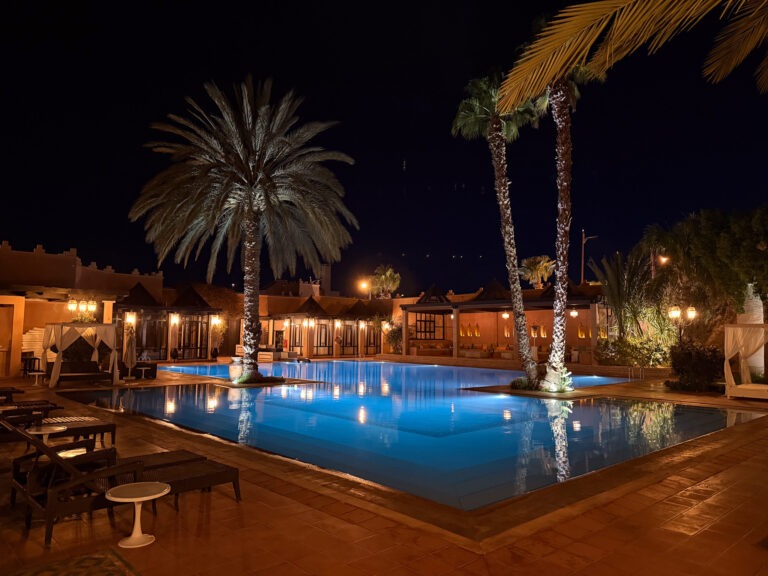
In Ouarzazate, we’re staying at the Berbère Palace. It’s a luxury hotel that justifies its price tag simply because so many Americans stay there. Ouarzazate is the Hollywood of Morocco. Numerous well-known movies have been filmed here, and the city’s wealth is clearly evident.
Hotel Berbere Palace
The hotel is a classic five-star property. The rooms are spacious and comfortable, and the beds are pleasantly soft.
The breakfast room is opulent and typically Arabic, and the buffet offers everything you could want for a hearty breakfast.
When booking, be sure to check that breakfast is included.
Restaurants in Ouarzazate
For dinner, we recommend La Datte d’Or.
Since it’s Ramadan, there’s only one set menu on the menu. But since we don’t want to eat the set menu, we ask if we can order something else—and what would be impossible in Germany is made possible here in Morocco. Of course, we get exactly what we want—and with a friendly smile to boot. Here, the guest is definitely still king, and they really go out of their way to make sure everyone feels comfortable.
For lunch, we recommend The Full Sun restaurant. It’s certainly one of the best restaurants in town, even if it doesn’t necessarily look like it from the outside. If the pictures on the wall are to be believed, Matt Damon has even eaten here, for example.
We highly recommend the pasta and the tajine kefta, served with French fries. The food is absolutely delicious, the restaurant is very close to the hotel, and the prices are very reasonable, with excellent service.
The restaurant also has very good reviews on TripAdvisor, though that’s likely mainly because a lot of Americans who arrive on tour buses also stop here to eat.
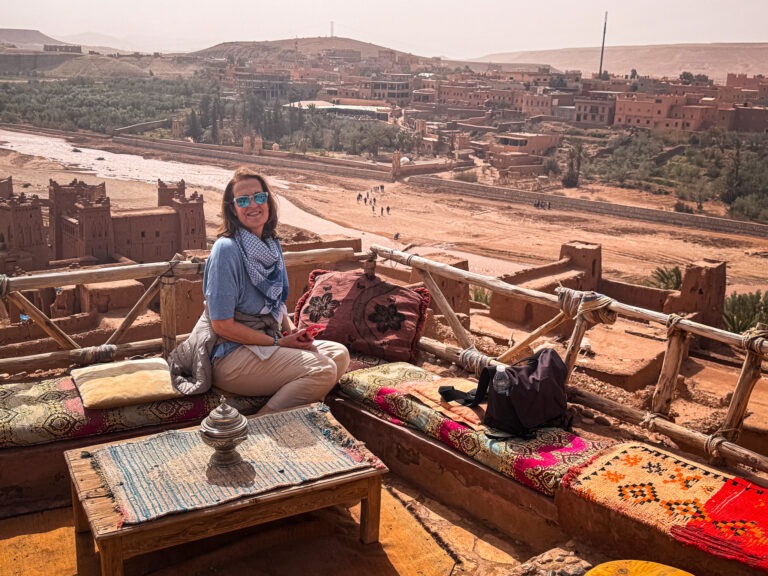
Ait Ben Haddou
The next morning, we continue on to Aït Ben Haddou, the desert town. It’s about a 40-minute drive from the hotel through a desert-like landscape.
You can’t drive into the interesting part of Aït Ben Haddou. You park in one of the parking lots in the newer part of town, where a few parking attendants are already waiting—much like in Africa—and for 20 Moroccan dinars, they’ll watch over your car.
To get into the town, you can either take the adventurous river bridge or a concrete one. Of course, we opt for the adventurous bridge.
The advantage of taking this route is that you enter the old town from the back, which also saves you the entrance fee.
*Gladiator* was filmed here, and the whole city feels like a movie set. In the alleys, however, you’ll find the typical vendors selling pottery, clothes, and souvenirs.
Further up, there are a few nice Moroccan-style cafés where you can take a break for tea or coffee.
All in all, you should plan on spending about 2 hours on the tour.
Kasbah Amridil
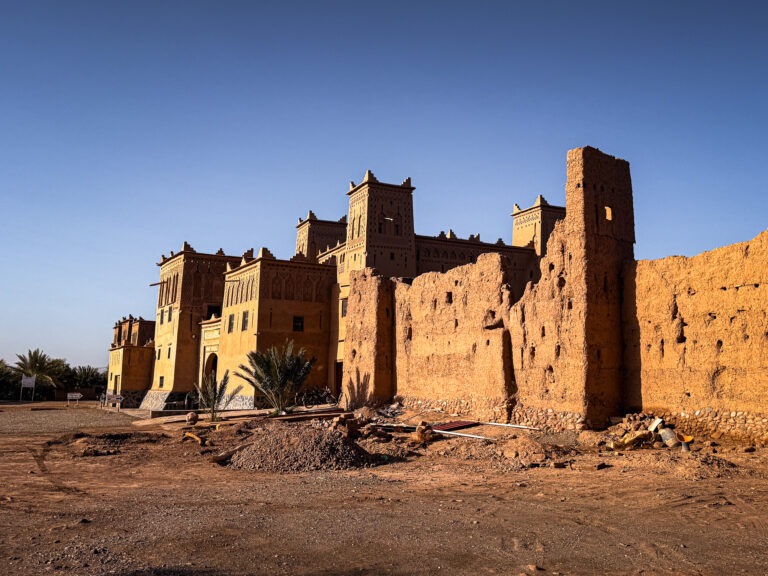
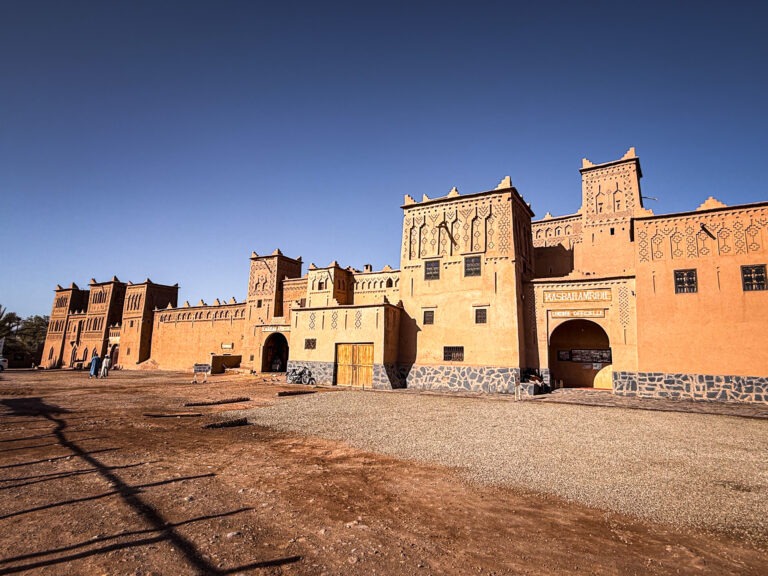
The Kasbah Amridil is one of the most beautiful in all of Morocco and is located about a 45-minute drive from Ouarzazate.
Admission costs about four euros per person, and you can choose between two different entrances, each with a separate price. The better choice is the entrance on the right, because from there you can climb the tower and enjoy a magnificent 360° view.
The Kasbah Amridil offers a good insight into how people used to live here. There are many small, interconnecting rooms that are certainly nice and cool in the summer, but also bitterly cold in the winter.
Dades Valley and Eden Boutique Hotel
From here, the journey continues to the Dades Valley.
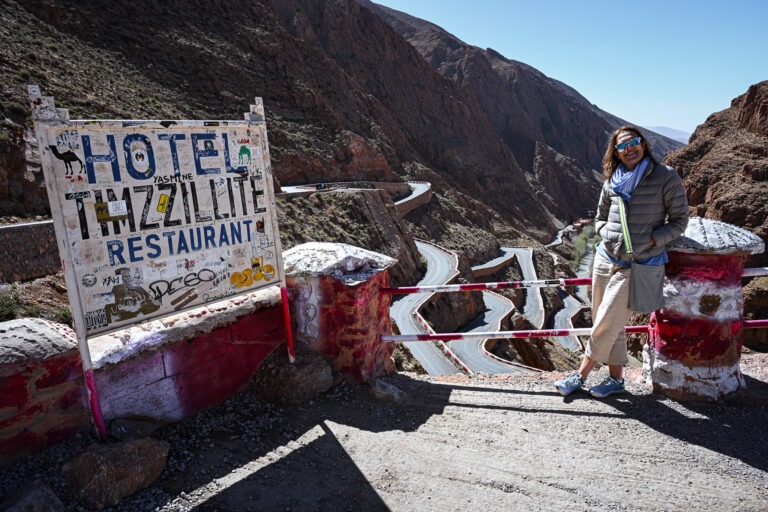
The valley features one of the most impressive winding roads in Morocco—and certainly one of the most impressive in the world. It’s an excellent photo opportunity—already impressive by day, but it would surely be most beautiful after dark, when you can see only the trails of light from the cars—if any are still driving at all.
Eden Boutique Hotel
This hotel, which only opened in 2022, is certainly one of the best hotels we’ve stayed at so far. In terms of value for money, the price is definitely well above average, but for us Europeans, it’s absolutely justified. The entire hotel impresses with every little detail and the care with which it was built. The owners are three brothers. They all grew up in the area and have really picked out the prime spot here, with a great view of the mountains.
The hotel currently has 18 rooms, and they don’t plan to add any more. Given the size of the hotel, however, you’d assume it had at least 50 rooms or more.
Ismail, one of the three brothers, gives us a warm welcome and asks if we’d mind waiting a little while for our room, as he’d like to give us an upgrade. Of course, we’re happy to wait, and the 30 minutes we spend with him fly by. The reward is certainly one of the most beautiful rooms in the entire hotel.
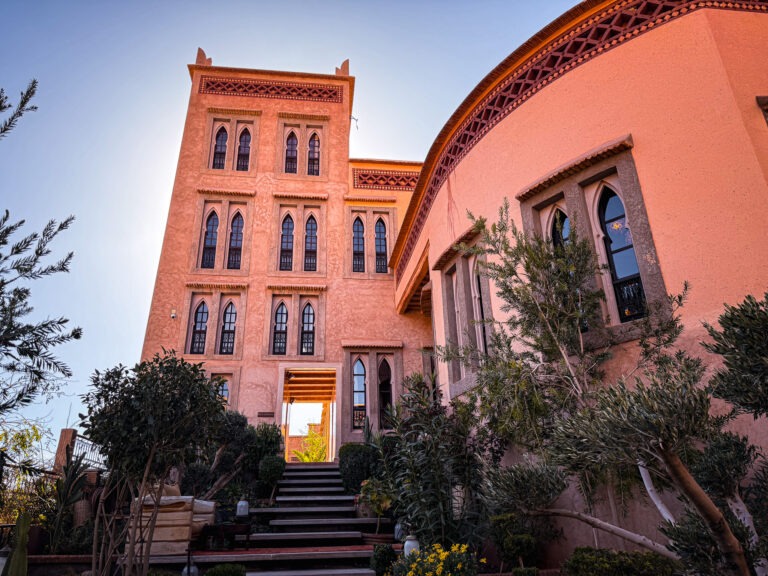
It’s more like a suite in size, and the view takes you straight to the mountains across the way. The hotel has an excellent restaurant, where we immediately reserve a table for dinner.
Since it’s Ramadan, there’s a set menu, but its quality and deliciousness are second to none. One of the three brothers is the chef, and we’ve rarely eaten so well.
Drink prices are definitely on par with European standards—for example, a 0.33-liter beer costs eight euros. At 50 euros per person, the 5-course menu is a real bargain by comparison.
The rooms feature a modern Moroccan design, and here, too, every single detail is just right. The beds are incredibly comfortable; we haven’t slept this well in a long time.
Breakfast is another very pleasant surprise. Instead of a buffet-style breakfast, as is common at many hotels, the buffet is simply brought right to your table. Our table is so full of delicious food that there’s almost no room left to put anything down. There are five different juices alone, and the egg dishes are served ready-made right at the table. Everything is freshly prepared, so we can enjoy breakfast to the fullest.
After breakfast, it’s time to pack our bags and set off on the next leg of our journey.
Merzouga and the Sahara
Today we’re heading from the Dades Valley to Merzouga in the Sahara. Google estimates the trip will take 4.5 hours. We’re expecting it to take more like 6–7. The total distance is just under 240 km. Now that we’ve left the Atlas Mountains behind, the temperatures are slowly rising.
After a 4.5-hour drive—exactly as Google predicted—we arrive in Merzouga at our hotel, Ksar Bicha. Coming from one of the absolute top hotels in the world, we’re initially a bit disappointed by this one.
Ksar Bicha Hotel
The hotel can probably best be compared to a typical Spanish three-star hotel. On the one hand, everything is very Moroccan; on the other hand, somehow nothing seems to go together. Since we booked directly through Ali, the owner, we probably got the best room in the entire hotel.
The cleanliness is rather mediocre, and unfortunately, that says a lot about the overall standard. It’s basically clean, but not as clean as one would hope. It simply lacks attention to detail.
Since we’d already arrived at the hotel at 2:30 a.m., we head next to Merzouga—what you might call a town. At a small restaurant, we treat ourselves to two pizzas. We probably shouldn’t have done that, because they weren’t tasty and sat heavily in our stomachs all evening.
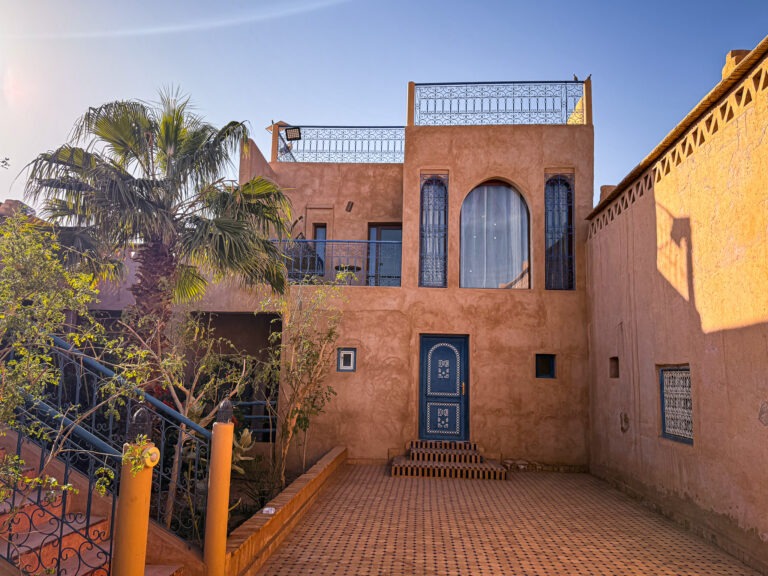
After that, we explore the hotel. It has a total of 20 rooms, and 13 more are currently under construction. No matter what you look at outside, everything is somehow covered in sand and therefore looks a little grimy.
We realize that, given the conditions here and the constant wind, it’s a challenge to keep everything clean and tidy. However, if the hotel were run more by women, things would look quite different.
The pool is beautifully clean, and if the temperatures had allowed it, we certainly would have gone for a swim there. But it’s still too cold for that in March.
For dinner, we have Berber tagine again, and it’s absolutely delicious. We’re a bit hesitant to try the salad with mayonnaise, though. Since the hotel doesn’t have a liquor license, there’s unfortunately no wine or beer to go with the meal. That’s a real shame.
Fennec Fox Safari
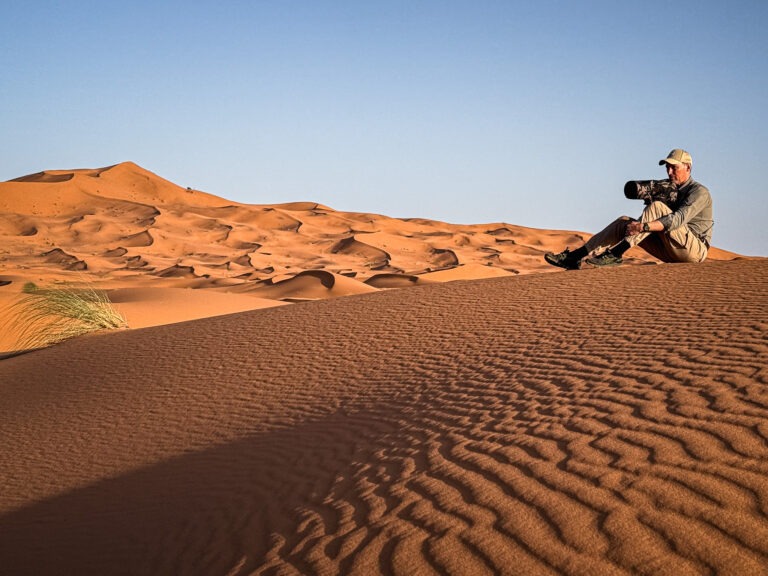
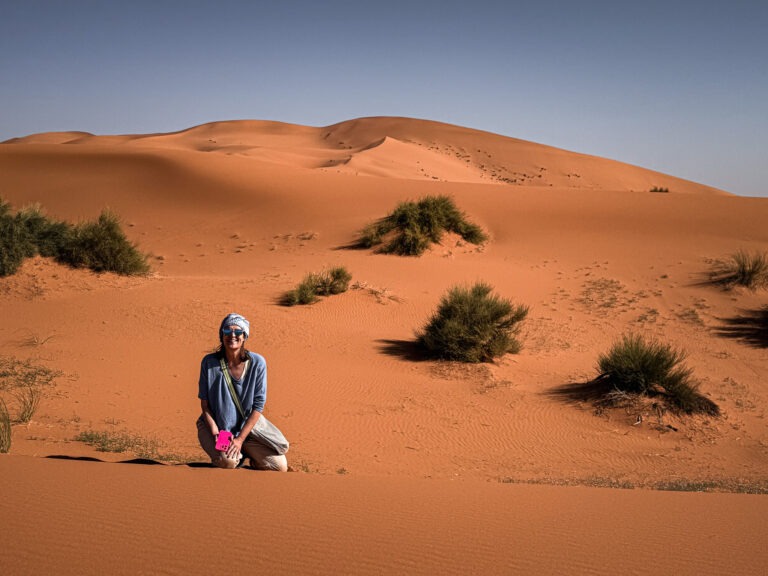
The next morning, after breakfast, we set off on this safari at 9:00 a.m. Ali, the hotel owner, is also our guide for the fennec fox safari.
After we let some air out of the Land Cruiser’s tires, it takes only about 30 minutes before we spot the first fox den—and we can hardly believe our eyes, because a small, young fennec fox is lying right in front of the entrance, completely unfazed by our presence. Little by little, we get closer to the fox den and spend a good hour capturing amazing videos and photos.
Afterward, we continue at breakneck speed across the dunes of the Sahara. Ali is an excellent driver, and normally a ride like this wouldn’t bother us at all. Today, however, the constant up-and-down and left-and-right motion is really turning our stomachs. And if there were such a thing as “Sahara sickness,” we’d say we have it.
Around 12:00 p.m., we stop for a break at the Ksar Bicha Desert Camp. First, we drink a Coke to settle our stomachs and rest a bit, so that we feel better again after a good half hour. Around 1:30 p.m., we’re served lunch here at the desert camp.
Lunch is delicious. Afterward, we have a chance to explore the camp before heading out at 4:00 p.m. for the afternoon drive.
The play of light in the desert in the afternoon is so beautiful that it’s hard to put into words. The shadows on the dunes, the red hues against the blue sky, and the light that grows softer and softer are breathtaking.
We spot a few more fennec fox burrows and even catch a glimpse of one or two foxes in the distance. But unfortunately, it’s too late to get any really good photos. We quickly realize just how lucky we were that morning—with a very trusting and not-at-all shy fennec fox.
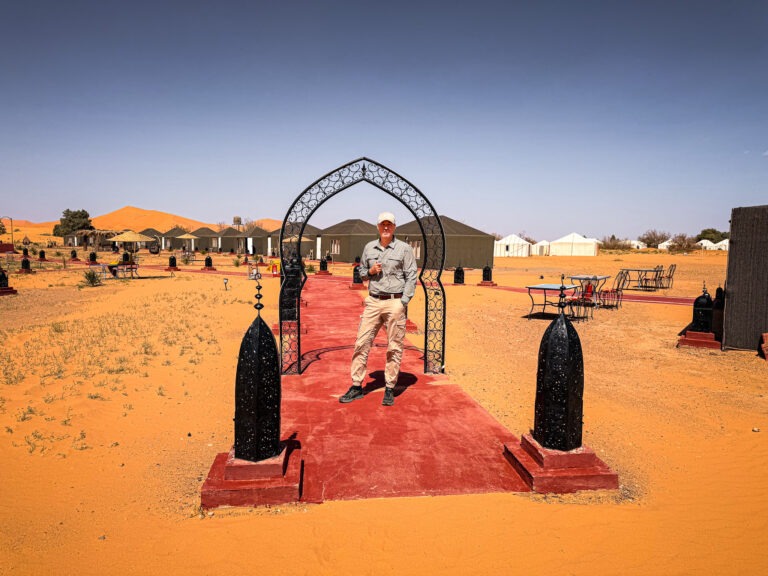
Around 7:00 p.m., we’re back at the hotel, have a quick chance to freshen up, and at 7:30 p.m., we enjoy a delicious dinner. We’re glad we opted for the vegetarian option every day, because they really know how to cook it well here.
Unfortunately, the hotel’s Wi-Fi is completely overloaded in the evening, so it’s not much use. But that has the advantage that we’re already in bed by a little after 9:00 p.m.
Day two starts just like day one: breakfast at 8:00 a.m. and departure for the foxes at 9:00 a.m.
The atmosphere in the morning is lovely again, though it’s nothing like the one in the afternoon. Once more, we find several fox dens and even see a fox’s ears peeking out of one or two of them, but it’s still not enough for really great photos.
Ali, our guide, really lets loose in the desert today with the SUV. We certainly didn’t miss a single dune that he didn’t race across at high speed.
Even getting stuck on one of the dunes can’t stop him from keeping his foot on the gas.
We do spot another fox and try to approach it on foot. However, it spots us so early that it disappears behind a dune. Either way, hiking across these unique Sahara dunes is an incredibly beautiful experience.
Around 12:30 p.m., we’re back at the hotel this time, where we enjoy a delicious lunch and spend the rest of the afternoon relaxing until 4:00 p.m.
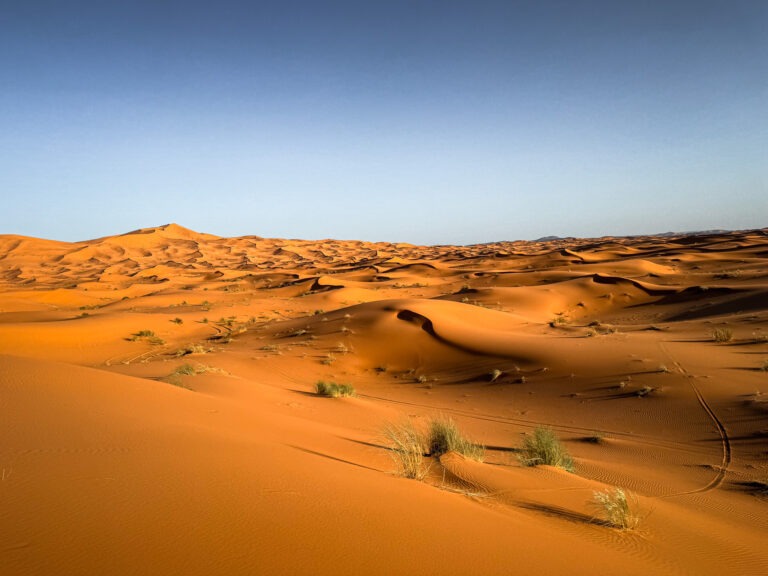
At 4:15 p.m., we’re off again. The play of light in the Sahara is simply incredible. Today, the dunes have taken on a completely different shape. The sharp edges and corners have given way to gentle curves and waves.
Depending on how the light hits them, the dunes glow in shades ranging from bright white to dark red—simply unbelievably beautiful.
Once again, we pass several fennec fox burrows, though all of them are empty. After about an hour, however, we spot an occupied burrow, and the fox peeks out with its ears.
We’re in luck—this animal isn’t shy at all, and if we stay quiet, we can get as close as about 10 meters.
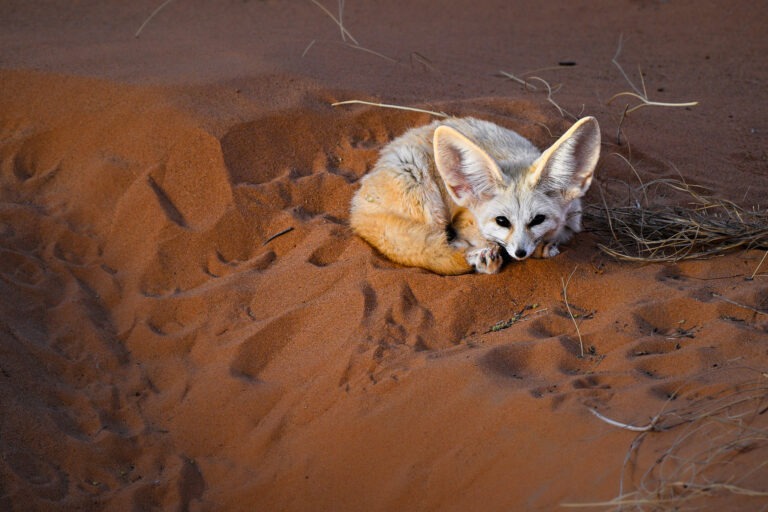
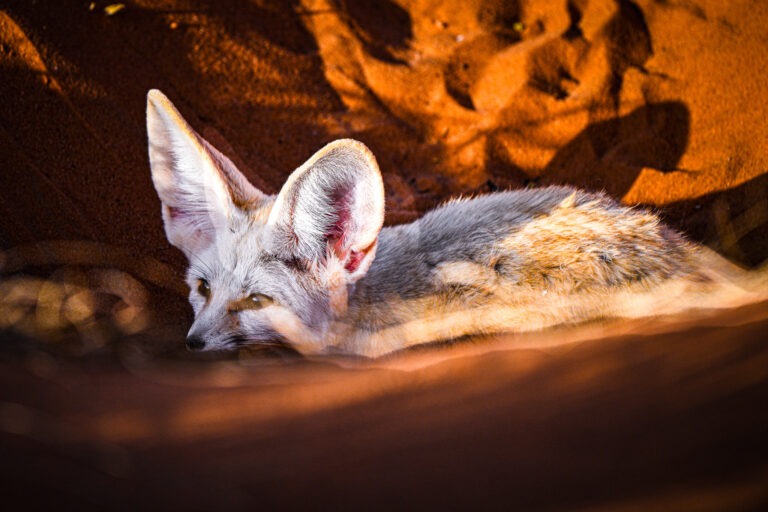
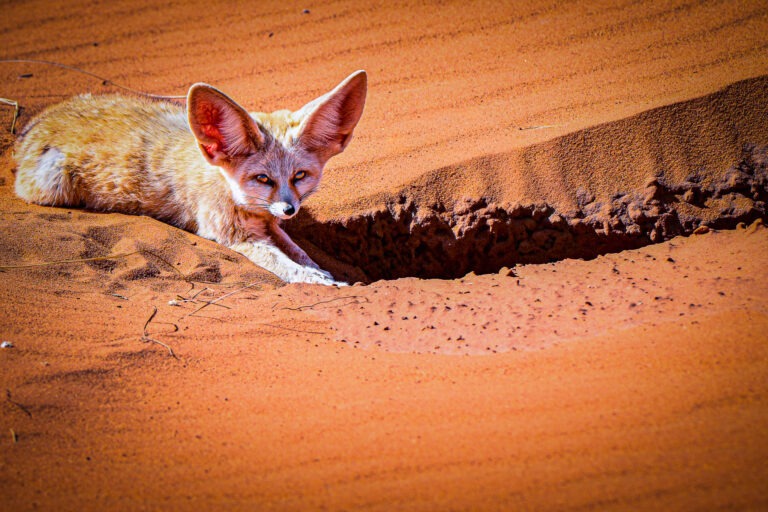
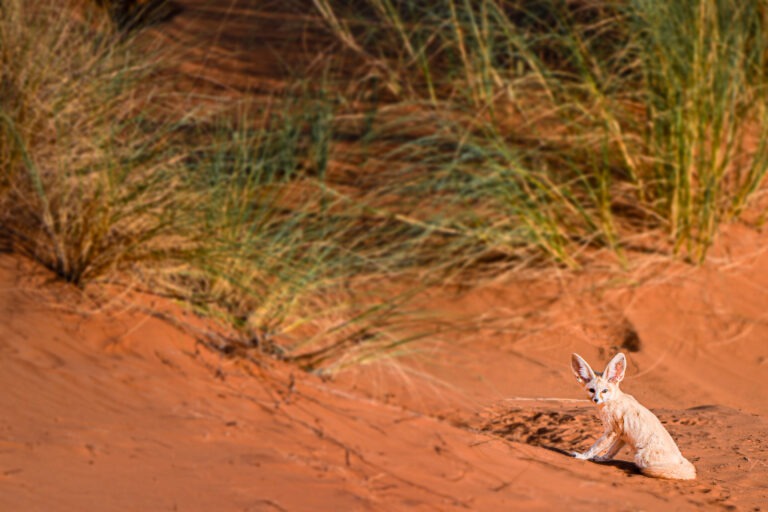
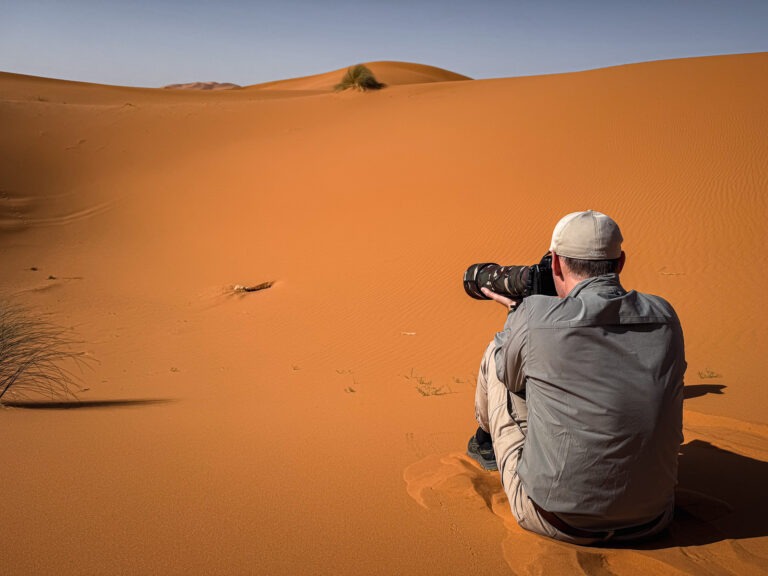
With the setting sun at our backs, we spend about 90 minutes with the fox. There’s no one else around but us. Unfortunately, though, we can hear the loud engine noise of the quad buggies in the distance.
For most visitors to the Sahara, it’s simply a giant sandbox where they ride up and down the dunes on motorcycles, ATVs, or rally buggies.
Unfortunately, the routes aren’t regulated, so these thrill-seekers repeatedly drive very close to the fox dens and the foxes themselves, disturbing the wildlife—if not actually injuring them.
It would be ideal to simply close off certain areas to these recreational tourists, but that will likely remain a wish and never become a reality.
Around 6:30 p.m., we head back to the hotel, where a delicious dinner awaits us, and with that, our fennec fox safari comes to an end after two days.
Trip to Agadir
After a quick breakfast, we set off at 8:15 a.m. toward Agadir. This leg of the journey will take just under 8 hours and cover a good 560 km.
The route is, on the one hand, incredibly beautiful and, on the other hand, incredibly tiring, since it’s just straight ahead for kilometers on end and the speed limit is 100 everywhere. Even though Andrea drives 130 on various stretches, our estimated arrival time changes only slightly. Unfortunately, we’re also pulled over by the police once along the way. We were going 7 km/h over the speed limit. We got lucky—it only cost 15 €.
Riad Haida
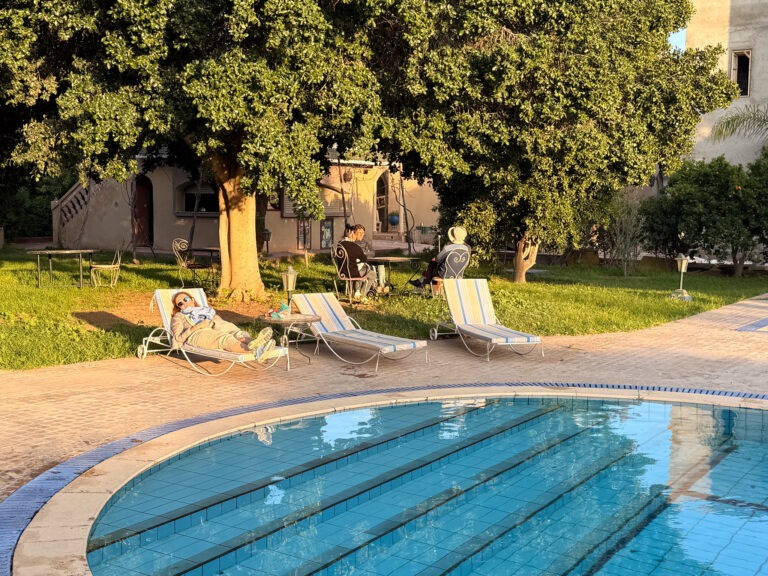
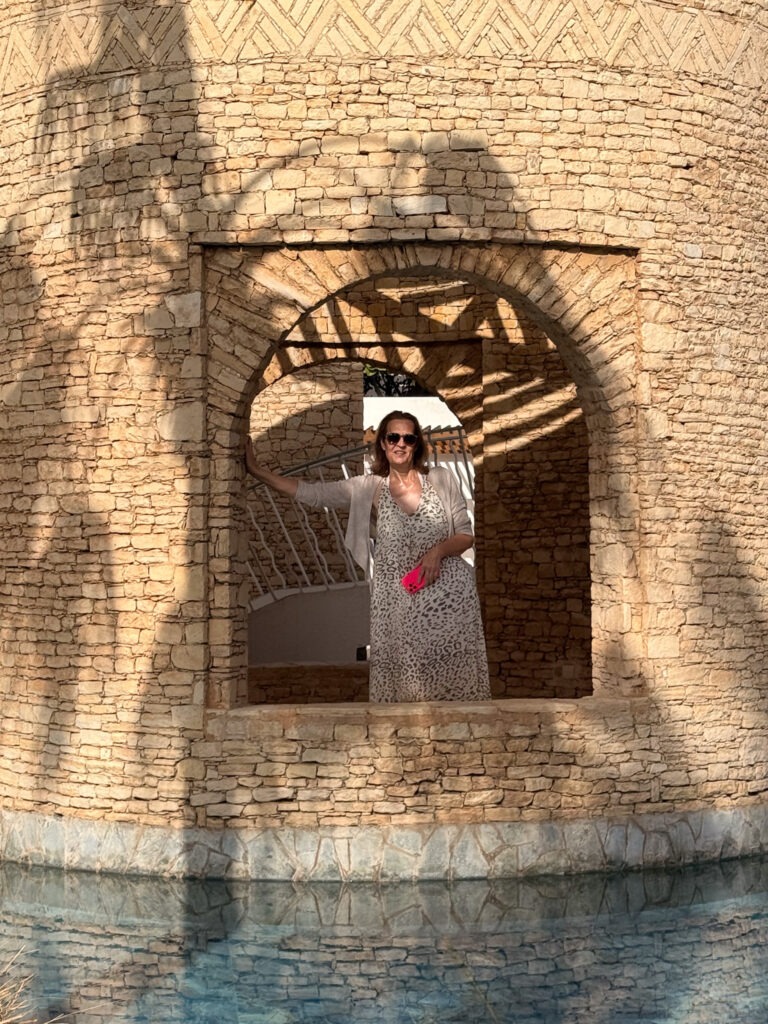
Our hotel for the night is the Riad Haida, a former palace that, unfortunately, is showing its age. The grounds, however, are incredibly beautiful and very, very large, and offer just about every amenity you could wish for. That said, it’s clear that there isn’t enough money to maintain this wonderful property.
It’s perfectly fine for a stopover, but again, it’s a somewhat borderline experience.
We won’t have to worry about being woken up in the morning, because the chicken coop with a rooster is right next to our room.
Contrary to expectations, breakfast is very good; everything is freshly prepared and tastes really delicious. Around 8:30 a.m., we pack our things anyway and set off toward Agadir.
The closer we get to Agadir, the more police checkpoints there are. Since we’re driving very slowly to save gas, it’s no problem at all.
Agadir
We drop off the car at the airport in Agadir and take a taxi to the hotel. Uber isn’t available here, and taxis must be paid for in advance. You also have to specify how many pieces of luggage you have, and the fare for them is included in the total. Even so, the taxi drivers try to rip you off again upon arrival and make you pay extra for the luggage. You’re back in the tourist areas, and the Moroccans think we’re stupid.
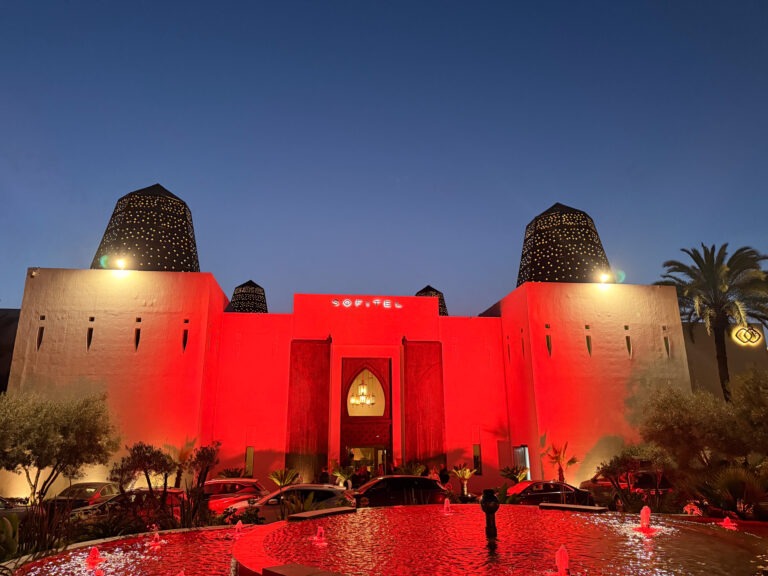
Sofitel Agadir Bay Resort
The hotel is located in a tourist area. Here on the beach, one hotel stands next to another—from Rio to Iberostar, and even Sofitel and Robinson Club.
In fact, there are actually two hotels: the Thalasso and the Resort. Unfortunately, we chose the Resort because we didn’t realize these were two different hotels. The Thalasso is actually the much more modern and better hotel.
The Resort also has a five-star feel, but unfortunately, you can tell from the details that the hotel is showing its age.
Dining
There are various restaurants offering different dining options, including buffet-style and à la carte. The food is of truly excellent quality, and even though the buffet—at just under 50 € per person—isn’t particularly cheap, it’s outstanding for the price and quite an experience. Drinks are not included in the price.
Pool
The pool area is very large, and there’s plenty of space for sunbathing, daybeds, and other ways to relax. As in all tourist areas, though, things get busy early in the morning: First come, first served—reserve your spot with a towel.
Rooms
The basic rooms aren’t particularly large, but they’re generally well-equipped. Unfortunately, the beds are a bit saggy, and the air conditioning is more of a token effort, as it’s only turned on when it’s really hot outside; otherwise, the hotel tries to conserve electricity.
Although the windows can be opened, they’re so small that hardly any fresh air comes in.
If you haven’t booked a pool view, you’ll either be looking out at another hotel or at the pile of rubble in front of it.
The rooms also aren’t particularly well insulated, so you can hear every chair being moved or every loud phone call from the neighboring rooms. We can’t recommend this hotel for the rooms, but if you value the food and a nice pool area more, you’ll be satisfied here.
Beach
The hotel is separated from the beach by the boardwalk. However, there is a small beach area on the hotel grounds, though it is man-made. This way, you can at least experience the feeling of being at the beach right next to the hotel.
Agadir’s beach itself is rather dirty and, above all, very rocky. Not exactly what you’d imagine a dream beach to be.
The truly beautiful dunes visible from the beach are part of a restricted military zone. And any attempt to even set foot there is immediately stopped by a soldier blowing a whistle. That’s a real shame, because that’s certainly the most beautiful stretch of beach.
Excursions
All kinds of excursions are offered from Agadir. Practically everywhere we went on our tour. In Agadir itself, a visit to the truly beautiful and very large souk is worth it at best. However, it has very little in common with the more traditional and even more beautiful souk in Marrakesh. In Agadir, you get the feeling you’ve ended up at a tourist market, especially since you’re supposed to pay a ten-dirham entrance fee during regular hours.
Restaurants
We tried Le Mauresque, a restaurant located about 1.5 km from the hotel, and can recommend it. It’s a higher-end restaurant with excellent service. All the appetizers were impressive, though the tajine kefta was the worst we had on the entire trip—but it was still okay.
Agadir is a typical tourist destination, and you can tell that tourism has brought money into the city. For us, it’s far too touristy, and we’d only visit Agadir again if we absolutely had to.
Conclusion
A road trip through Morocco is an unforgettable experience, especially if you can drive yourself and set your own pace for the journey. The constant speed checks and the sometimes very long drives across the country can be challenging.
But once you arrive at your destination, all that is forgotten. Our main reason for the trip was to film and photograph the fennec fox. Next time, however, we’d choose a different hotel in Merzouga and hire a different tour guide.
We’d definitely visit the Eden Boutique Hotel again, which is a great stopover between Marrakesh and Merzouga. As for Agadir, we won’t be visiting it again—at least not on our own accord. It was definitely nothing like the Morocco we’d experienced before, and if you’re looking for a pure beach destination, the Canary Islands are a better option by comparison.
Want to order a calendar from our photo trips?
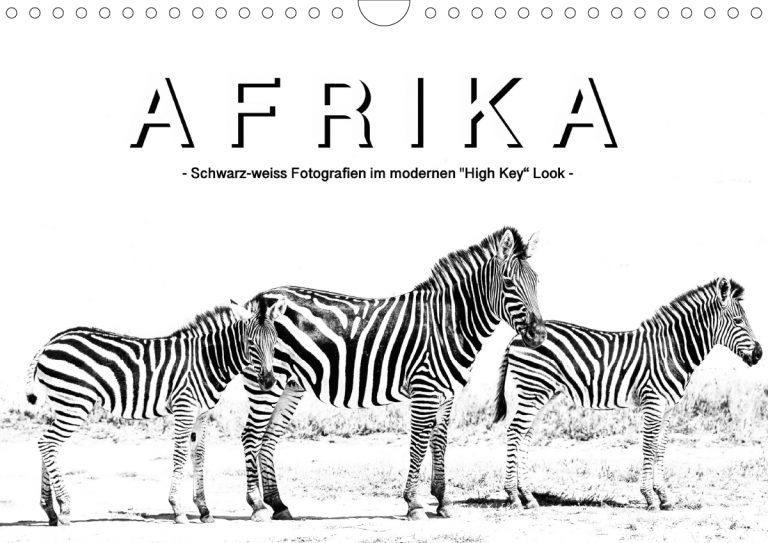
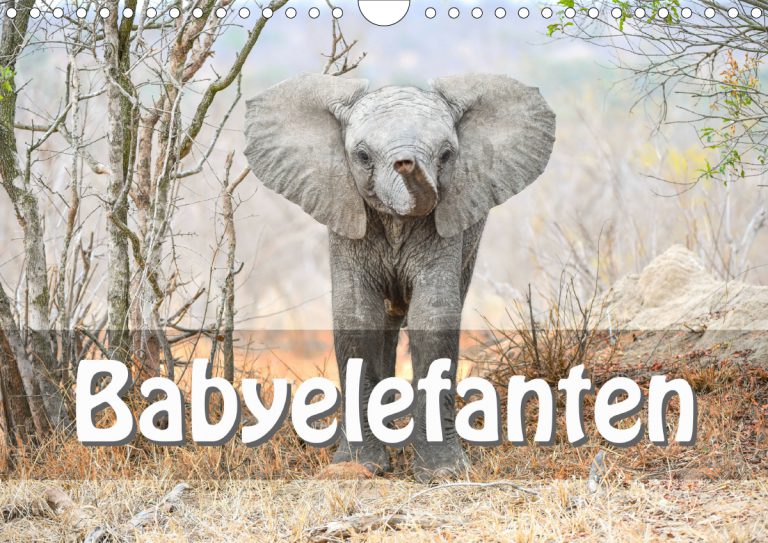
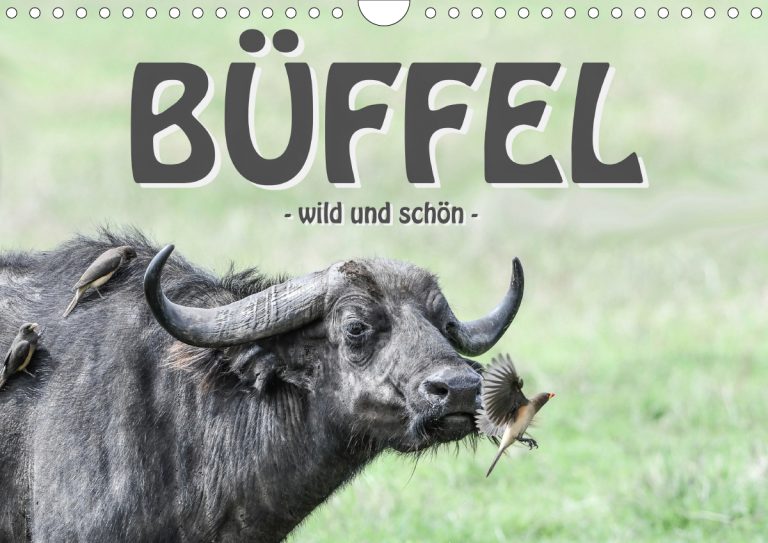
starting 18,90€, sizes A2-A5

What photography gear should I bring to Morocco?
The photography equipment we took with us to Morocco is listed below. You can also order the equipment we used directly through our Photo-Shop and find out more technical details. There are also plenty of extras available there.
Cameras:
- Z8 (Nikon)
- Z7ii (Nikon)
- Apple Iphone 16pro max
Lenses:
- Z 180-600mm f/5.6-6.3 (Nikon)
- Z 70-200mm f/2.8 (Nikon)